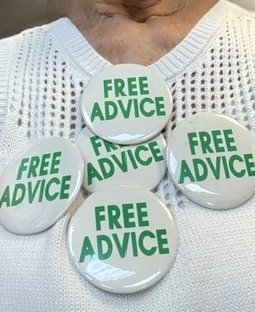
A hundred Free Advice buttons arrived in a plastic bag as part of a donation to the thrift store — New4You — where I volunteer. I couldn’t resist adorning myself with a few of them.
Surely this was the button message meant for my blog readers. After all, most of us have stored up plenty of advice in the form of wisdom and experience to share with our adult children. But the question I raise time and again in posts is, should we offer it? As our children have blown past their toddler years and teen times, we have been morphing too. We’ve had to go from advisors–don’t put that dirty stick in your mouth; those shorts are too short to wear in public–to a counseling role. That is, to oversimplify, if they come to us today and ask us if they should dye their hair purple, we can feel free to say, “I’m a little slow on today’s styles, but purple’s never been your color.”
I have passed the buttons around with much glee to friends and fellow volunteers with adult children. (Lemme know if you want one.) Some of us doubled over in laughter at the thought of wearing the button the next time we saw one of our children.
But beyond the fun of it, these buttons hit home. I wish I could rejigger them to add just below the big green letters a note in smaller black type: But only when asked.
photo:selfie
PARENTING GROWN CHILDREN: The children may be grown but we still have our issues.
Can I afford the rent? Will I ever be able to buy a house? These questions are top of mind for our Gen Z and Millennial kids who feel priced out of the housing market–and who may be part of the army of young adults flocking back to our previously empty nests. They may need to save on rent in order to come up with the cash for home ownership.
The housing crunch is also leading to a generational divide. WSJ and several West Coast outlets see a fight over housing in San Francisco’s Marina district as not only pitting an older generation (long-time homeowners bent on protecting their neighborhoods from new multifamily housing) against a younger one (tired of NIMBY arguments about high-rise developments marring views). It may also be a sign of political fights to come.
In covering the contretemps over the Marina housing proposal, which calls for two high rises each around 20 stories high, the Business Insider took note of the older generation wanting to protect the look and style of its neighborhood, while the younger Gen Z and Millennials, desperate for reasonably priced housing, see the older generation as keeping them out of the housing market.
What’s happening in the Marina District is something of a microcosm of the housing crisis across the country.
While most lawmakers are homeowners — 80 percent, by one count — the youngest politicians are often renters, like the vast majority of Americans under 35. Others still live with their parents
The issue has become urgent enough to push our youngish adults into running for office on a platform of housing affordability.
This NYT article looked at a new generation of Millennial and Gen Z politicians who are making housing costs and affordability central to their campaigns because they experience the housing squeeze personally.
David Morales the youngest member of the Rhode Island Legislature and who is a renter, ran for mayor of Providence, RI, saying he wanted his city to be a place “where you don’t find yourself priced out when it’s time to renew your lease, a city that’s not dominated by luxury housing.”
Manny Rutinel, who is a Democratic state legislator who is running for Congress in Colorado, has been working in the state legislature on housing affordability issues. He told the Times:. “For people like me, this is deeply personal.” I’ve “watched my own rent go up 15 percent year over year. I’ve. seen my mom choose between keeping a roof over our heads and pay for essential medical procedures. I’m running for Congress to lower costs.”
Juliana Bennett, a 26-year-old Democrat on the City Council in Madison, Wis., who is running for State Assembly, puts the issue this way: “We can freeze the rent today, but we’ll still need 200,000 new homes tomorrow,”
All I can say is, good on them and other candidates for doing something about their plight. If they can make some changes and get affordable housing built, they could help ease the housing crisis–and move out of their parents’ formerly empty nests.
Painting: Rebecca Lemov
PARENTING GROWN CHILDREN: The children may be grown but we still have our issues.
Here we are again: Looking at an issue we’d probably rather not think about. When it comes to our retirement savings and other accumulations of worldly goods, it’s no longer a given that, once we pass on, our kids and grandkids will be awash in newfound wealth or a modicum of cash. Unless we’re fabulously wealthy, there may not be much of our worldly goods left for them. Left, that is, after we age gracefully or not so gracefully out of this world,
I’ve written a post here on the underlying falsity in headlines that forecast $68 trillion to $84 trillion in money and assets changing hands over the next two decades. That transfer does not account for the high cost of care as we age into less healthy bodies and minds. I feel like the canary in the coal mine–having faced down my share of “caregiving” costs for my spouse (but not yet for me)–and now I’m joined by the Washington Post, which ran this story
As the cost of aging soars, families’ wealth is evaporating
Growing old is eroding the inheritance Americans hoped to leave behind
Many will have nothing to pass on.
The Post findings are based on an analysis of the finances of thousands of seniors in the last decade of their lives. Using data from the federally funded Health and Retirement Study, the analysts found
For many families, the cost of care eats away much of what they had hoped to pass on.
Within a growing segment, elder care costs are not just diminishing their savings, but obliterating them.
The latter is even worse news for our adult kids. They may end up spending their own savings to cover our care.
The major factors the Post lists for creating the proverbial perfect storm of loss include: .
We’re living longer. “Medical advances have made it possible to successfully manage many chronic diseases. But that has people paying for more years of care than in the past.”
Care has gotten increasingly expensive. “The costs of senior living facilities have soared. The median assisted-living rate increased 44 percent in five years, according to the CareScout surveys, nearly double the rate of inflation.
Demand exceeds supply. “The sheer size of the baby boomer generation is increasing the demand for resources and contributing to rising labor costs and, in turn, the price tag of long-term care.
ICE isn’t helping. Neither are low rates of pay. There is “a growing caregiver shortage across health care.
Not the kind of summer reading we’d like to linger over in our lounge chairs.
I’d love to end this post with a “Here’s What You Can Do About It” advisory. Yes, upping the savings can help, but there are limits. There is no way of knowing how much we’ll need. Or, as the Post story puts it, there is an inherent uncertainty in how much is enough.
Will someone die of a heart attack at age 75? Or will they need 10 years of the most intensive and expensive care?
Nearly 1 in 5 people will require high-intensity care for more than three years, according to 2025 research from Boston College’s Center for Retirement Research.
I’m going to close this post and get back to reading The Director by Daniel Kehlman. It may be grim but it’s more diverting than checking on my nest egg.
Painting: Arshile Gorky, “Gorky and His Mother”
PARENTING GROWN CHILDREN: The children may be grown but we still have our issues.
The older we are — make that the more mature we are — the more likely we are to lean in on the politeness tropes of “please” and “thank you.” Before we travel, some of us even make it a point to learn how to say “por favor” or “takk” or “arigato,” depending on where we’re lucky enough to be going.
I hear occasional complaints that “thank you” (TY in text talk) has morphed into “no problem” (NP if you’re texting). “No problem,” however, is very much a means of being polite. But there are signs of a generational split in how we express politeness or how we use the terms we associate with being a gracious person.
Discontent along these lines came in a communique to the NYTimes’ Social Q’s column. The ever-polite and reasonable Philip Galanes was asked by a pair of grandparents to comment on the failure of their adult son and his spouse to teach their son —the grandparent’s 5-year-old grandson —to say “please” and “thank you” at appropriate moments. Have times changed?
It turns out there is research on the use of politeness terms among Gen Zers.
Sociologists at UCLA found that younger people use words like “please” much less frequently in casual conversation than older generations and that they tend to use it strategically.
The study, published in Social Psychology Quarterly, explained the more strategic use of “please” this way: “Whether passing the butter or driving someone to the airport, non-strangers say “please” to each other to sweeten a request when they know the other is likely unwilling, either because they have resisted already or because they are busy doing something else.”
The findings suggest less effort is put into teaching prescriptive, “one-word-fits-all” principles; there is more focus on how to be sensitive to the particulars of a situation.
“Any generic rule – like saying “please” and “thank you” – doesn’t take into account the specific situation,” one of the researchers reported. It “may not always indicate respect or politeness.”
Galanes’s answer to the offended grandparents mirrored these findings:
“Many young parents are teaching their children manners…by modeling polite behavior for them and with gentle reminders. There are fewer barking commands….It focuses on the spirit of politeness, rather than its performance.”
As to correcting the grandson —a point raised by the grandparents who made it their business to do so —the gist of Galanes’s advice was to butt out and just enjoy the company of their grandchild, a lack of “TY” notwithstanding.
painting: Pierre Bonnard, “One Summer Afternoon”
PARENTING GROWN CHILDREN: The children may be grown but we still have our issues.
We walk into our kid’s apartment and, yuck, there’s cat hair covering the sofa, dustballs in the bathroom and greasy fingerprints all over the refrigerator. Are we within our “rights” –are we exercising “good judgment”–so say something. Or, if not say something, do something like ask if we can treat them to a deep clean?
To judge by reader responses to this point in a Carolyn Hax column, this is another “Keep your mouth shut” area. It’s as charged as comments on an adult child’s weight, hairstyle or the way they dress.
The mom in Hax’s column was concerned that her daughter’s messy apartment was not just a matter of poor housekeeping but a health threat. Would it be okay, the mom asks, to offer a one-time clean-up service?
Here’s what Hax and others had to say about the urge to butt in.
HAX:
Yeah, I see no role for you here. Anything can be a “health issue at some point” — including excessive cleanliness — so it’s not a magic portal into her business.
READERS:
The desire to not be judged for petty housekeeping stuff is the No. 1 reason I dread my neat-freak mother-in-law’s visits. If you want your daughter to want you to visit, then keep your yap shut.
My mom’s addendum to the “keep your mouth shut” advice is “and your wallet open.” Obviously this is only if you are financially secure enough, but I think a one-time, “You work so hard. I would love to help. If you want to book a cleaning service once a month, I’d be happy to cover it,” would be okay. Best delivered if/when she herself shows some frustration.
My daughter was thrilled when I offered to pay for housekeeping. I waited until she brought it up by apologizing for how dirty her apartment was — but once she opened that door, I told her that I understood how busy she was, how hard keeping up must be and offered to pay for a one-time service. She accepted. Twenty years later, she has a busy job and two kids, so I still offer to pay for a housekeeper once in a while. It’s what she requests for Christmas.
HAX:
And no to the cleaning-service offer. There’s only one context in which it’s not judgy, and that’s when there’s a life-event connection. New home (housewarming gift), new child, surgery, huge project, etc. Or, of course, if she complains about having to clean.
Painting: Frank Auerbach
PARENTING GROWN CHILDREN: The children may be grown but we still have our issues.
They’re back. Damp towels on the floor, dishes in the kitchen sink, eyes trained on iPhones. Our young adult kids are coming home and moving into their old bedrooms or our basements. It’s a trend that’s accelerating.:
Nearly half — 44 percent — of U.S. parents with adult children ages 18 to 35 say a child has moved back home at some point. Thus reports a recent poll by Thrivent, a financial services company.
Many of our kids are returnees thanks to financial pressures. The top strains:
reduced income,. (Entry-level wages aren’t keeping pace with inflation.)
AI’s threat to the stability of white collar jobs, especially at the entry level.
That’s only half the story. The Thrivent survey also found that 50 percent of the re-nesters are not feeling a tightening of purse strings. They’re planning for the future. They may be saving for a down payment on a home (34 percent of young adults gave that as their reason to come home for a while) or to launch their own business (with or without use of your garage).
If our kids are re-residencing, we are entering into a relationship with them known as economic interdependence. To find our way through this phase, financial gurus have some tips:
There’s a difference between providing a safety net and enabling financial immaturity. That is, there needs to be a balance between short-term support and long-term independence. “The goal should really be to use this period to build towards financial stability and not delay it,” says Gene Elder, a financial consultant at Thrivent
Communicate whether and how the move home is impacting the family’s finances. This silent sacrifice can be costly. Nearly 45 percent of parents are willing to slash their own everyday spending to help their adult children. Turns out, two out of three boomerang kids say their parents have never communicated how much supporting them affects their parents’ long-term financial planning.
As to setting the day-to-day means by which you live together, a frank two-way discussion tops the list to figure out the ordinary and the personal, such as rules about kitchen clean-up, bathroom protocols and overnight guests, to name just three hot buttons. While a full discussion can help keep things on an even keel, Michele Singletary, the Washington Post financial columnist. is succinct about the bottom line: “Your roof, your rules.”
painting: Madis Oru, “Dirty Dishes”
PARENTING GROWN CHILDREN: The children may be grown but we still have our issues.
We Baby Boomers have been financially favored. A good number of us rode a rocketing stock market and rewarding jobs to ultra-healthy investment portfolios. The eventual transfer of those assets to our grown children–spoiler alert: we won’t live forever–is the stuff of media chatter about the $100 trillion in wealth we’re likely to fork over to our heirs over the course of the next two decades. It’s being called The Great Wealth Transfer.
But is it? What this hoopla doesn’t take into account is that we upper-middle-class boomers who’ve accumulated our tiny piece of these trillions of dollars of wealth are living long lives.
For a 65-year-old couple, there’s a 64 percent chance that at least one partner will live beyond 90.
For many of us, retirement can last three decades or more.
All of which means that the pleasure of leaving our kids and grandkids a financial bonus is giving way to fear of outliving our assets. That’s because growing old and fragile doesn’t come cheap.
Here’s what financial advisers have to say:
One of the biggest factors that drives wealth depletion during retirement is health care costs, including rising out-of-pocket costs for medical treatment and the probability of needing long-term care later in life.
These potentially high expenses increase the likelihood that most of our their savings would be wiped out during their lifetime, leaving little or nothing to transfer to their children or other beneficiaries.
The projections on the likelihood of being faced with these costs go like this:
Women vs. Men: Women have a higher probability of needing care (57 percent by age 85) compared to men.
Average Duration: The average person needs care for roughly 2.5 to 3.6 years, but 22 percent of adults will need care for more than five years
When I previously posted about thisissue, I wrote from personal experience of how jarringly expensive it was to care for an infirm spouse. This is especially true when a loved one suffers from one of the big three causes of debilitation among the elderly: stroke, dementia, Parkinsons. The costs of care vary, depending, of course, on the extent of care needs and local costs of that care. But I can tell you, the costs I incurred (I needed around-the-clock non-medical care for my spouse) could wipe out $1 million in savings in a flash of three or four years.
Congress continues to hold hearings on the “financial risk to every individual’s retirement income security posed by long-term care needs.” Thus spaketh Senator Charles Grassley when he chaired a hearing to identify steps to help Americans better prepare. The consensus, certainly among those in power at the present moment, is that we holders of a piece of that trillion-dollar portfolio should save more. But the question is: How much is enough?
Painting: Pierre Bonnard, “Dining Room in the Country”
PARENTING GROWN CHILDREN: The children may be grown but we still have our issues.
I’ve over-shared my concerns about leaving clean closets for our kids. When we’re no longer around to tell them what’s a sentimental treasure and what’s just junk, we want the curating job to have been done. By us.
Now there’s a new twist on clean closets: financial cupboards. While this form of storage doesn’t have the heavy lift of pulling out boxes from under our beds, it still has things that need to be cleared and cleaned up.
In one of her columns, Michele Singletary offered clean-up advice. What you need to take care of depends on what generation you are. For us Boomers (those of us 62 years old and upwards), she doesn’t have clean-out suggestions so much as a to-do list: Create a Letter of Instruction. It should include:
Usernames and passwords to your mobile phone or computer.
The location of your original will or trust documents.
An inventory of your important papers, including financial accounts, insurance policies (life and home), retirement and pension information, or veterans’ records.
And by the way:
If you’re going to keep the letter on your computer, be sure to print a copy or save it to a flash drive in case your computer can’t be accessed.
Update your beneficiary designations. There should be “Payable on Death” (POD) and “Transfer on Death” (TOD) names on every account that match your current family structure. That’s one way to avoid probate.
This clean-up isn’t too formidable, is it? You’ll feel all tidied up when all the pieces are in place, and then you can forget all about it. Except to tell your spouse or kids where the Letter is.
art: Hilary Precis
PARENTING GROWN CHILDREN: The children may be grown but we still have our issues.
There’s only one person in this photo gripping her phone.
Last week I spent a two-day mini vacation with my son and granddaughter. We stayed in the Old Town section of Alexandria, Virginia. Our one big tourist outing was Mount Vernon.
Guess who decided not to bring a phone along to wander around George Washington’s estate? It wasn’t me. It wasn’t my son. My Grand, a high school senior, said she didn’t want to be distracted. She wanted to focus on the history of animal life on the estate and how slaves lived and were treated. She left her phone in her hotel room.
Her dad and I were very impressed, though she brought up one caveat. “If we get separated, you won’t be able to text me.” We managed to stay in touch the old-fashioned way. When she wanted to wander off to see something we were uninterested in, she knew which bench we’d be sitting on.
I tell you this for a reason. My granddaughter seems to be part of a growing trend among younger people. It’s called “digital detox“:
Despite being digitally active, some research suggests younger generations are purposefully taking breaks from social media and managing their screen time.
Older adults are part of a different trend. Ours could be called “High Screen Tme.”
We’re becoming more reliant on technology, often exceeding younger generations in our use of digital devices. That usage includes mobile devices but also–and notably–television, and desktop computers. The latter do not have a large presence in the Gen Z world.
I find this thought-provoking. Yay for Gen Z. News about their Digital Detox versus our High Screen Time is creeping into mainstream media. To wit:
“Are boomers the real iPad babies? Why Grandma and Grandpa can’t seem to stop scrolling.” A recent Washington Post. headline.
“Once seen as a Gen Z problem is now quietly gripping an entirely different generation. Screen addiction, it turns out, has crept into the lives of older adults and it’s tightening its hold.” A report in Asianet News
Cheers to my Grand and the growing number of Gen Z’s who are finding joy in human interactions, not just digital ones.
photo credit: family iPhone
PARENTING GROWN CHILDREN: The children may be grown but we still have our issues.
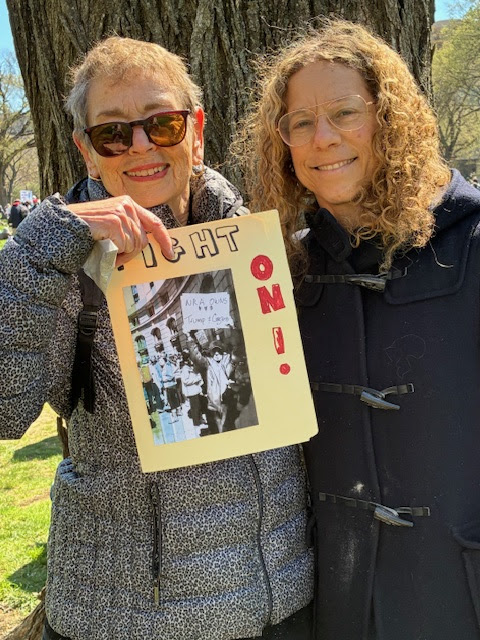
Some anniversaries are joyful. Others are simply meaningful. And others are meaningful with a touch of sad. The weekend of No Kings marked the second anniversary of Mike’s (my husband’s) passing. If Mike hadn’t been born a political protester, he was one by the time I met him as a young man. He kept that drive alive for the next six decades. So it seemed fitting to commemorate the anniversary of his death by taking him (well, just his likeness and a spoonful of his ashes) to the March 28 rally on the Mall in Washington, D.C.
His daughter (and mine) flew home to make the Fight On poster (see above) with a photo (below) of Mike at a protest rally some eight years ago. Then we headed downtown.
As the crowd gathered on the Mall and the speeches began, as the worst moments of the Trump presidency were called out to a roaring crowd, my daughter and I took turns holding our poster high to make sure Mike’s presence was counted. We also found a discreet place near a large tree overlooking the Capitol to dig a teeny tiny hole and leave a teaspoon of his ashes.
Bringing Mike to No Kings made the Second Anniversary of his passing more meaningful and less sad. There was a joy in it. We did right by him.
So here’s to our grown children. Not mine in particular. All of our grown-up children and the issues that have surfaced in this blog. However much we may fret about them, disagree about their life choices or wonder what they’re thinking when they opt for a tattoo or purple hair, it doesn’t matter. When they are here for us if we need them, count us fortunate ones.










 PenPenWrites